

A Dietitian’s Deep Dive into The New Perimenopause by Mary Claire Haver, MD.
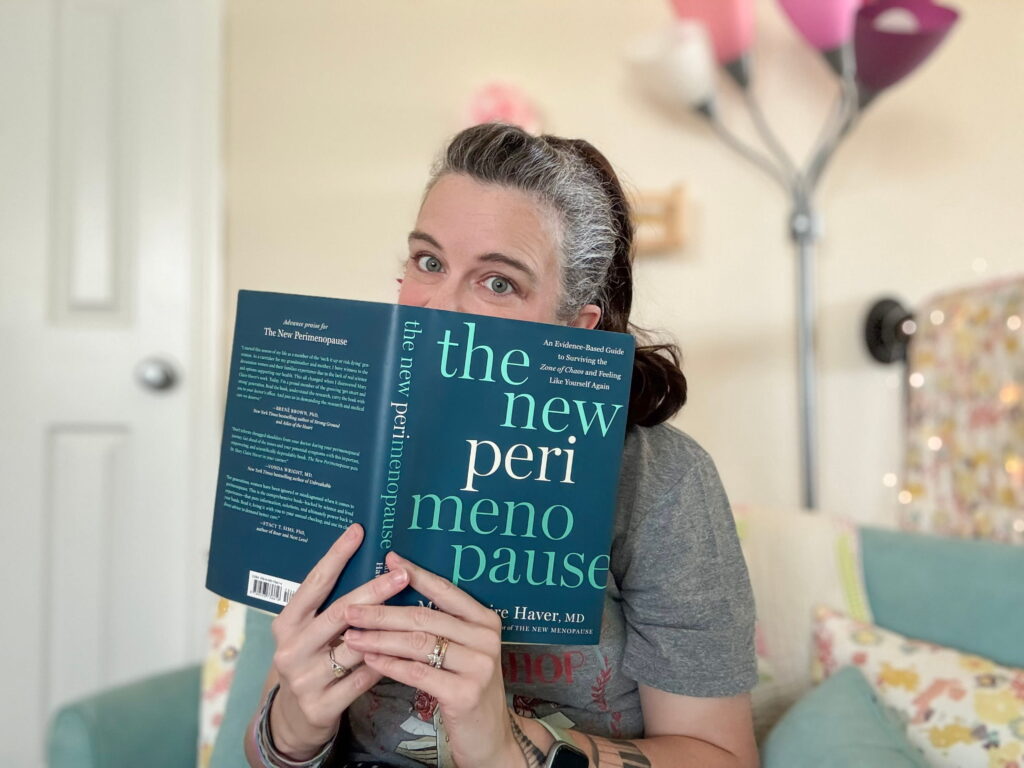
Welcome to the very first post of the 2026 Summer Book Club! This summer, I wanted to start walking through the topics of perimenopause and nutrition, so we’re reading The New Perimenopause by Dr. Mary Claire Haver, MD — and I genuinely cannot be more excited.
A quick note before we dive in: I’m a Registered Dietitian Nutritionist, not a Medical Doctor. I work closely alongside physicians, and my goal is to explore this book through my professional lens while sharing what I see in my own field. Nothing here is meant to throw shade at any profession. This is about understanding, learning, and advocating for ourselves.
The majority of women I work with are in or approaching perimenopause, so this book is deeply relevant to not only my work — but honestly, to my own life as I’m knocking on the door myself! By the time I finished Chapter One, I was fired up. Let’s go!
Our Summer Reading Schedule
Here’s how we’re pacing through the book this summer:
- Today: Introduction + Chapter One
- In two weeks: Chapters 2 & 3
- 2 weeks after that: Chapters 4, 5, & 6
- Then: Chapter 7, followed by the remaining chapters
This series will run through the end of August. I’d love for you to read along with me in between episodes so we can really dig into it together.
A Letter Worth Reading Twice
Dr. Haver opens this book with a dedication that I just had to share. I really feel like her passion and drive is clear, and it really sets the tone for everything that follows:
“For every woman who was told is was all in her head. For those who were dismissed, misdiagnosed, handed a vague label and a bottle of antidepressants instead of real answers. For the clinicians who are listening, truly listening, and learning alongside their patients, even when the textbooks come up short. For the researchers who dared to challenge the early conclusions of the Women’s Health Initiative – you faced resistance, skepticism, and institutional inertia, but you pressed on in pursuit of the truth. Because of your courage, an entire generation of women may finally be seen, heard, and cared for with the rigor they deserve. And for my daughters and yours- may they enter this transition armed with knowledge, supported by science, and empowered by a healthcare system that no longer treats midlife as invisible.”
– Dr. Haver, 2026
I mean, whew. That says everything, doesn’t it?
A History of Dismissal
Dr. Haver opens the introduction by describing her own journey within the traditional healthcare model – a model that, historically, has responded to women’s health concerns with dismissal. Symptoms get chalked up to being “in your head”, being dramatic, or “just the way it is.”
As I was reading, I kept thinking about historical fiction (of which I have read a lotttt. The parallels felt almost Victorian. That image of an old gentleman physician with elixirs, patting a woman on the head and telling to calm down. I know we aren’t in the 1800s anymore, but the echoes of that mindset have continued on, lasting far longer than they should have.
The good news is that we’re finally starting to break away from it. There’s now real, peer-reviewed research that validates women’s lived experiences- the emotional shifts, the weight distribution changes (from the booty to the belly), the muscle changes, the mental health impacts. These things have always been real. They just haven’t always been taken seriously, or connected to what’s actually happening, hormonally.
Generationally, I think we’re at a turning point. Gen X women are solidly in this phase right now, trying to catch up. Millennials, like me, are entering the conversation for the first time. And for my daughter’s generation, I really believe that it’s going to look completely different. I’m super grateful for that.
Let’s Define the Terms
Before anything else, Chapter One clears up some terminology that I think a lot of us get wrong — including me, honestly.
Menopause is not a season of life. It’s one single moment in time: the point at which you have gone 12 consecutive months without a period. That’s it. One date. It typically occurs between ages 45 and 55.
- Before that moment = Perimenopause (peri = “around”)
- After that moment = Postmenopause
Perimenopause can begin as early as the mid-30s, and on average lasts about 4 years — but it can last up to 10. Buckle up, buttercups…
And here’s something a lot of people don’t realize: postmenopause is the rest of your life after that one moment. Symptoms like hot flashes, heart palpitations, and night sweats can actually increase and continue for years into postmenopause. So when you zoom out, you could have up to a decade of perimenopausal symptoms, followed by one “day” of menopause, followed by years more of symptoms. This is a major chapter of a woman’s life, and it deserves serious attention.
The Status Quo: What Women Have Actually Been Experiencing
The prevailing assumption in healthcare has been that you’re only in perimenopause if you have hot flashes and irregular periods. Everything else is minimized, misattributed, or ignored.
Dr. Haver shares an example of a woman who mentioned changes in her libido to her doctor and was told to — I’m not joking — “just relax and have a glass of wine.” That is real advice being handed out to real women. And it is wildly disrespectful.
As for the weight conversation, I have a lot of feelings about this one. As a dietitian, if I hear one more story about a woman going to her doctor with sudden, unexplained weight gain — weight she hasn’t changed her habits for — and being told to simply “eat less and work out more,” I will lose my mind. That is not a sufficient answer. It is not accurate for everyone. It dismisses a real and complex physiological experience, and we have to do better.
The Data: What’s Actually Happening to Women
Dr. Haver conducted a community survey in 2024 with over 800 women. The top five symptoms — all experienced by 80% or more of respondents — were:
- Hot flashes & night sweats – 86%
- Weight gain and redistribution – 82.4%
- Anxiety, depression, & panic attacks – 82.3%
- Sleep disturbances – 81.7%
- Fatigue – 80.6%
These are not edge cases. These are near-universal experiences. If your doctor is still treating these symptoms as outliers or coincidences, that’s a problem.
From a nutrition standpoint, I want you to know: dietitians can help with several of these. Hot flashes, night sweats, weight redistribution, GI issues like bloating (which affects about 70% of women in this phase) — these are areas where nutrition and lifestyle support can make a real difference. We can’t make hormonal changes disappear, but we can help you navigate them. Please don’t overlook us as part of your care team.
And if you’re a dietitian reading this: please continue educating yourself on the hormonal impacts of this life stage. Even if a client comes to you for something entirely different, there may be connections worth exploring. This has been part of my own continuing education, and I’m grateful for it.
Why is This Still Happening? The Root Causes.
Limited Medical Education
According to Dr. Haver, medical schools offer very little education on perimenopause — in part because research in this area has historically been so sparse. I understand that context. But here’s where I’ll gently push back: limited education is a factor. It is not an excuse.
If 80% of your patients are walking through the door with the same complaints, that’s your signal to learn more. Dr. Haver did exactly that when she personally went through menopause and decided enough was enough. Educate yourself. That’s the cultural shift we need. I’m not here to throw shade at the entire medical profession — there are doctors out there who are listening, who have always been listening. But the systemic gaps are real, and acknowledging them is step one.
The 17-Year Evidence Gap
On average, it takes 17 years for new research to change clinical practice. I’ve witnessed this in my own work — outdated recommendations still being handed out as gospel long after the evidence has moved on. In a world that moves as fast as ours does, that lag is simply unacceptable.
Updated Guidelines being ignored
In 2022, the Menopause Society presented updated, evidence-based guidelines to a major medical board. Those guidelines were not adopted. The board is still operating off 2014 standards — guidelines that don’t even mention perimenopause or osteoporosis prevention. I genuinely don’t understand how that’s acceptable.
Staggering Underfunding
This one genuinely blew my mind. The NIH has an annual budget of $50 billion. Of that, roughly 8.8% — about $4.4 billion — goes toward women’s health research. And of that $4.4 billion, less than 1% goes toward menopause research. Less than $44 million out of $50 billion.
For a condition that affects nearly every woman and touches blood pressure, bone density, insulin resistance, mental health, sleep, joint pain, and cardiovascular health — that is wildly insufficient. When the funding isn’t there, the research isn’t there. When the research isn’t there, clinicians don’t have the tools to help. It’s a pipeline problem, and women are paying the price.
If you want to take action, Dr. Haver points readers to pauselife.com, which has a Citizen’s Guide to Menopause Advocacy.
The Mental Health Piece
Dr. Haver notes that antidepressant use doubles during perimenopause. She’s careful — and I appreciate this — to acknowledge that yes, sometimes clinical depression is present and antidepressants are an appropriate treatment. But the bulk of mental health shifts we see in this phase are hormone-driven, not mood disorder-driven.
She advocates for patients to be offered a conversation about hormone replacement therapy alongside a referral to a mental health professional. Both/and, not either/or. Science and compassion are not mutually exclusive. They can and should exist together. I love that framework.
Why This Matters? Quality of Life
Dr. Haver ends Chapter One with something that really hit me. She writes (page 23):
If you’re like most of my patients, your priority is getting through today without collapsing from exhaustion, crying, feeling intense angst or anxiety, or without wishing you could disappear. Your priority is to feel more like yourself, whatever that looks like.
Dr. Haver, 2026
That is what we’re talking about. Quality of life. This isn’t abstract — it’s blood pressure, bone density, insulin resistance, sleep, mental health, joint pain, and the ability to show up for your family and your life. This affects nearly every woman, and it deserves to be taken seriously.
Resources and Next Steps
If you are struggling with your mental health, please know that help is available. The 988 Suicide & Crisis Lifeline is free, confidential, and available 24/7. You can call or text 988 anytime to connect with someone who can help.
From a nutrition standpoint, if you’re looking for support navigating symptoms like weight management, GI issues, energy, or especially your relationship with food during this season of life — I am currently accepting new one-on-one nutrition counseling clients. If that’s something you’ve been thinking about, reach out. I’d love to work with you.
And please — read along with me! Pick up The New Perimenopause by Dr. Mary Claire Haver and join us in two weeks when we cover Chapters 2 & 3.